Feeds:
Posts
Comments

Archive for the ‘art therapy’ Category

Ok, here’s the “mostly” final picture, at least it is the image that represents most closely what I was trying to express in my journal.  The problem again was with the media, as I had complications from layering the media.  I was intending to do thick transparent layer between establishing the background details and basic foreground image and some enhancements to details in the foreground and some features in the background that I wanted to float over the initial image, so I put down a coat of Golden clear gel.  But I accidentally put some rough grooves into the gel layer that interfered with my ability to smoothly lay down this second layer of detailing over the first, and the rough surface had no tooth for adding media.  It was really frustrating.  I adjusted the tooth by adding 2 layers of clear gesso and finished editing the image, which seemed to give me the details a little better, but when I put a layer of matte acrylic sealer, I got a haze over various parts of the image, some of which is consistent with the pronounced grooves, and some of it where I used graphite, stains, colored pencils and conte to complete the image detailing.  Here it is in the current form, with the haze very apparent:


sg0145

I have now sanded this in some areas and knocked off the peaks though there remain some raised areas of the acrylic gel.  Though I tried to limit the sanding around the main image areas that were edited in the second layer, I still lost some of the work, and have made one final attempt to clean it up.  I’m not 100% happy with the image aesthetically, because it is difficult to rework it at this point without risking losing some of the detail that I really like, and I already feel that I’ve overworked it in some areas as it is and I don’t want it to become muddy, so I’m stopping any more edits to the image itself at this point.  All that I am focusing on now with the work is to try to bring up the clear finish until it is as smooth as possible and there is no more haze. 

I’ve added a layer of clear tar gel, though I had already removed the picture from the wood backing that kept it stiff and taping it back on did not give me a completely flat surface to pour over.  There are some slight waves in the paper now, despite its thickness.  So what I’ve done was to do the pour with clear tar gel and used a straight edge like a scree to try to make the gel top surface as flat as possible (trying to avoid adding texture to the surface if possible).  I’m afraid that the final image may have lost some of the nice detailing that is visible on physical inspection that isn’t as clear on the scanned image, but we’ll wait and see.  The clear tar gel is still drying right now.  However, I can already tell that much of the transparency has been restored, and I’m just waiting for the gel to completely dry so I can see if there is any remaining haze. 

From a technical standpoint, there were a few surprises and lessons learned about the media that I was working with, besides what I mentioned above.  One was that once I started putting acrylic paint & stain on the paper, my colored pencils didn’t work well at all, even after adding clear gesso over it.  I had a clear feeling that the pencils had to be pressed harder than would have been tolerated by the acrylic without looking scratched.  I used acrylic stains for several areas of coloring, like the background and in particular all the coloring of the tree stump.  Some was diluted with blending gel, and some was not diluted.  I used staining medium for the first time, which is really cool, because once you mix it with the acrylic paint, if it dries, it is reworkable indefinitely until it is sealed, which made it very much like watercolors.  This was especially cool because, just as I got my paint pallet of pre-mixed stain colors ready to do some adjustments, one of our cats started misbehaving in the next room and I had to stop and deal with that, and my stains had already started drying on the pallet, but were easily refreshed with just a bit of water. 

Notice the looking glass in the background (rose colored).  The story is in the next post. 

Read Full Post »

Ok, so I slept on the last version, and thought there was something missing from the “story,” thought it needed some fine tuning to the background, maybe detailing in the image, but as I’ve been learning about this process every time I do it, is that the process gives the lessons to me, and I get them when I get them.  When I woke up yesterday morning, I knew that the core image was only a piece of the story that the picture needed to show.  It needed to be put into context, and in doing so, the big picture of what I was really trying to express started to unfold.  I didn’t see it, and I didn’t see the layers that I have carried around for so many years, layers of shame and blame and self-contempt for every misstep in my life, even before I ever committed them.  But I’m jumping ahead.  These figures needed to be put into a context to be able to answer the question, “What was I thinking/feeling then?”

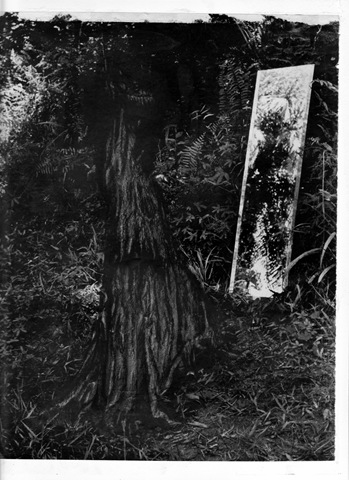
I searched for a background image that would enable me to complete the picture.  What I found in an old magazine was this:


sg0143-1

Lovely picture from an old magazine about old movies, in fact.  The only problem with the picture, is that there is a woman standing in the middle of the picture.  Other than that, it has all of the missing elements.  The wooded setting was/is idyllic for me.  It’s where I felt a sense of peace and belonging.  And then there is that looking glass, a perfect combination for me because I was never 100% sure which side of the looking glass I was on.  This is the perfect combination to round out the context for this picture to enable me to tell the whole story about the state of my mind in this image, and sets the stage to tell the story that I would really say to my son at that time.  So how to address integrating these elements with my current painting?  Remove the woman and draw what belongs there in my story:

sg0144

A gnarly old tree trunk in a forest does not interfere with my story.  In fact, I like this picture by itself, even outside of the story. I drew this with charcoal and graphite pencils, utilizing some of the light of the woman’s image to the extent that it works.  Now I have an altered photograph, over which I will overlay my working image, then continue.

Read Full Post »

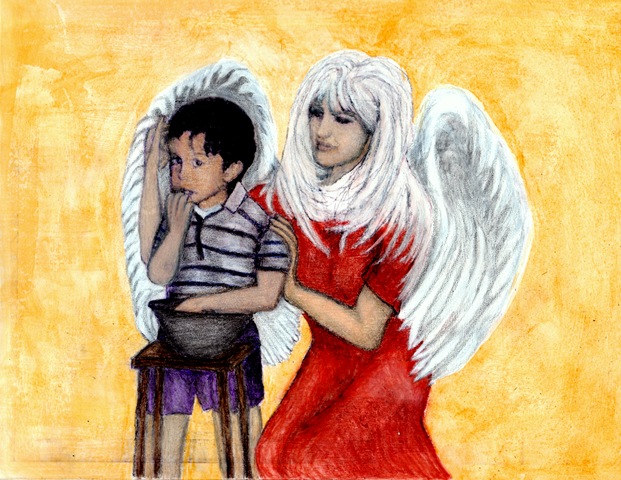
I have just a bit more work to do to polish this version of the journal page, smooth out some of the details, revise the background a bit and put a thick finish on it, but it’s mostly done.  Artist details:  mixed media:  graphite, charcoal, colored pencils & chalk pastels, acrylic, image transfer (a portion of my son’s face).


I really wanted to capture how I felt about my son when he was too little to remember.  Thinking about my kids is a big part of my bliss, and this really says it all.  I was so young myself that I really wanted to show him how very much I wanted him and loved him and hoped that I could be a really good mom to him.  He was indeed my little angel.  This journal page is a reminder of how precious he was and how privileged I felt to be his mom.

angel of mine stage 2

Read Full Post »

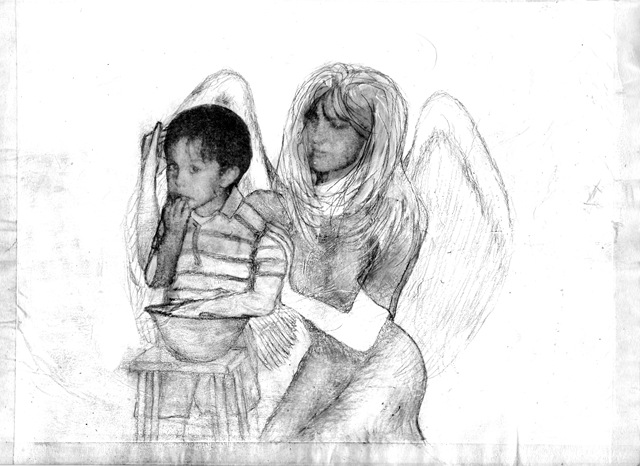
Angel of Mine stage 1

I’m just starting to develop this composition, so this is stage 1 of this piece.  This is a portrait of me with my son, my first angel, when he was between 2-3 years old.  I am about 23. 

Read Full Post »

Ok, this entry is not about a particular entry in my art journal, but my thoughts about what I’m learning about myself in the process today.  The pages are me getting down visual representations of thoughts and feelings at a given time, sometimes in a given moment.  It doesn’t even matter for me if that moment has passed in terms of time, because the image flashing in my mind’s eye brings me back vividly to the memory and how I felt and thought at that time quite easily.  What is helpful about bringing those images out of my mind and onto paper, is that looking at that page allows me to reflect on those thoughts and feelings in a different way, and I find myself trying to understand both where I was coming from and what I can learn from that, to shape my perspective and expand my own toolkit of life.


So I have been thinking about the journal page that I posted yesterday, and trying to decide what I was trying to tell myself.  The facts are that information/instruction/treatment was provided to me in a form that I was supposed to rely upon, and that information was wrong.  Where I have been feeling stuck is that the survival adaptation part of my brain is screaming that the rules as I understood them and used to keep myself safe were wrong.  Relying on a pure left-brain approach to the problem to understand and apply generally accepted rules for living, interpreting facts, acting in reliance upon professionals based on a set of assumed criteria, and even the criteria for extending trust and having confidence about what they provide—is broken.  What I have been feeling unsure about is what is exactly broken, and more specifically, how can I feel safe and confident to go back out into the world and be effective as a whole individual?  And what have I actually been doing as a process to achieve that?

Well, first was recognizing that something was clearly broken somewhere, based on the facts.  Something was wrong, I went to doctors of various kinds that I was sent to as recognized and recommended experts, in many cases specialists in particular kinds of problems, sometimes generically expert, like my primary care physician, Dr. Clark, and the outcome of all of the time, money, surgeries, treatments, drugs, tests, evaluations, was that the truth of what was wrong with me was missed-repeatedly and consistently by almost every single doctor.  I believe that I am developing, through my journaling, what was missing, and I have some the beginning of some ideas about how to address that going forward.

First, I’m looking at my process for problem-solving when faced with a new situation/set of facts and the need to adapt and survive.  Before I know that I’m dealing with something new that I don’t already understand, and that adapting to that new reality is necessary for survival, I have probably been feeling ill-at-ease in some hazy amorphous fashion, without a clear sense of what is underlying these feelings.  I’m distressed and uncomfortable, but I don’t know why.  Before I begin to feel that way, I’ve probably been working mostly in a left-brain sense with a set of rules that I apply to my situation, and for the most part, the parameters that I am relying upon seem to be working, and my right-brain function is something that I do for personal pleasure and balance.  The left brain world is a predictable and safe world because things fit together in logical, predictable ways, over and over again. 

Background

I don’t know if I ever was attracted to pure left-brain modes of thinking and living.  If I was, I can’t remember it.  I don’t know if I was pushed into right brain perspectives by exposure to life being inherently unpredictable and unsafe since an early age (even predating the fall at 5 years old, there was serious illness requiring hospitalization even before that), or to a parent’s perception that life was this way because they grew up with a “rulebook of life” that taught them that life could be devastatingly unpredictable and unfair, and survival required a great deal more than what could be extrapolated from objective analysis based on generally accepted facts.  I do know that what most distinguishes my parents from one another and why their marriage was doomed from the outset are how polarized they are in this regard. 

My mother grew up in a somewhat parallel world to me (perhaps to a lesser degree), where the generally accepted rulebook of life and assumptions that people generally relied upon to survive and prosper did not work in her childhood.  She had a very abusive father who maliciously hurt his wife, children, grandchildren, and others, and a mother who was not capable of protecting herself or her children.  I think she spent most of her life struggling with how to reconcile that, and her own self-esteem suffered as a consequence.  I feel certain that at least one of her assumptions was that she was supposed to be able to see the world and function in the world as if the standard rulebook applied to her, yet she knew that things didn’t work that way in reality, though the enforceable rule was that one was never to air one’s dirty laundry in public, so secrets were kept and as a child, predictably, she internalized a sense of failure.  This approach, however, has proven untenable for her, and in order to survive has repeatedly had to adopt more right-brain approaches to problem solving in order to survive.  The emotional conflict and the underlying damage to self esteem of trying to apply a “round peg” set of assumptions and rules to her “square peg” reality that she knew intuitively would work has been profound.  The irony of it all is that most of the time she devalues in herself what are strengths that actually positively set her apart in an evolutionary sense (in my opinion), and focuses on the damage that actually resulted from trying to “fit in.”

My father’s childhood was the opposite.  Life was uncomplicated and practical, and the rules that he learned served him well when he only had to serve his own needs.  Life was very much A + B + C = D, and when something or people came into his life that didn’t fit that in a way that interfered with his ability to enjoy living in his A + B + C = D rulebook, he would remove them and replace with what did fit.   As a child, he was not prepared to understand and cope with complications outside of that, and the choices that he has made have been to eliminate them by removing them from his path, and continuing on his journey.  Revisiting those choices is not something that he has ever been willing to do, I think because it has never been necessary in order for him to survive and prosper.

Had I been more like my father, I could have sidestepped some of the complications (and complicating people) that came along, but not most of them.  Some I simply could not have avoided, like being molested by my grandfather, being battered by my father, the accident at 5 and the long history of illnesses, my parents’ marriage breaking apart and being abandoned physically by the age of 12, emotionally and physically neglected long before that, were all things that I could not adapt to on my own during that time.  I could not protect myself then, though I made immature attempts to find creative solutions on my own at the time.  It’s been helpful for me to reflect on the various ways that my siblings and I have developed our own perspectives, and how we apply them to our present-day realities.  Each has developed strengths around resilience, adaptability and creativity in general, though each of us, including myself, continue to struggle with significantly low self esteem, and varying degrees of emotional dysfunction that pop up at various times, most notably during periods of high stress and stressful familial interaction of some kind (death in the family, family conflict, celebratory family gatherings, etc.).  And how we cope with instability varies, as well.

Present Situation

My dilemma is that I have discovered that I have relied, to my detriment, on the expert advise and treatment by a whole series of doctors over many years, who repeatedly and egregiously got it very badly wrong, and I will suffer the consequences the rest of my life.  The little girl/inner child in me is screaming at me that it is my fault because no one can really be trusted, and while that perspective may be valid for a child living in an environment where those that are entrusted with their protection are the ones that she needed protection from, it is not useful for this adult, and doesn’t improve my chances for survival, much less prosperity.  I have to have a basis for establishing trust and reliance upon others, because there will be times when I will need it.  In discussing this problem recently, I was advised that even if a doctor in the future might be wrong, that I should trust that they were doing the best that they could do, and that should help me to feel better/safe/etc.  That should be my rule.  My reply was, that this rule would not work for me, though I needed time to sort out the problem with the rule.  I only knew that it wouldn’t work for me, because it wouldn’t enable me to feel safe.  It may work for others in typical life situations, but my life is anything but typical. 

I may have developed some insight into how to formulate a better rule.  While what they got wrong can now be recognized as objective facts, in order to get to these objective facts (i.e., what was the wrong answer and what was the right answer), a specialized set of capabilities were necessary, along with a willingness by the person possessing them to utilize them in a particular way in order to arrive at the answer.  The capabilities require significant left-brain/right-brain integration in problem-solving abilities, along with a strong ability to assess when and how to apply them.  The professionals that I have maintained trust with, were those who had these capabilities and willingness and desire to apply them in their work with me.  Unfortunately, the majority of health care and related providers tend to be more heavily on the left-brain end of the spectrum, and atypical, unpredictable, unusual explanations for problems are not likely to be recognized or understood by them.  Most are less intuitive, less creative, and not likely to perceive or intuit things that are rare and occasionally unique.  They may not be stimulated by things that are unpredictable and, like my father, may be conditioned to sidestep complications by abdicating care-giving responsibility if they cannot explain the situation with logical, known scenarios that they were trained to treat in a measurable, predictable manner. 

Without exception, this accounts for every single professional that I can recall ever working with about my health problems, who both got it wrong AND lost my trust.  What I recognize sets apart those that I do trust, even if they haven’t always gotten it right, were that they are both professionals who recognize that whatever list of explanations about a situation they have been trained to understand and help to develop solutions for, there are always other possible explanations and solutions, that they just don’t know yet, and they don’t put their egos in between what they have previously understood as the realm of possibility and likelihood, and what might actually be the truth of the matter.  They both demonstrate strong L-/R-brain integration, a perpetual “on-the-job training” mentality, keep their egos in an appropriate place, and respect that my information and interpretation of the facts that I suggest may be relevant should be approached with a view that any or all of them may in fact be relevant, and should be integrated with their accumulated scientific knowledge and expertise to collectively arrive at the truth as it unfolds, allow those aha! moments to happen, not take it personally, and develop a plan that addresses the reality, however novel it might be to them. 

In order for me to have confidence and trust in that professional, I must know that they are able and willing to listen to me and recognize when they need to shift from left-brain predictable approaches to incorporate right-brain creativity to the problem-solving process.  This is when I need them to stop behaving like a “deaf man” by filtering what I tell them through what are predictable explanations and dismissing or ignoring what doesn’t fit (declaring that it’s all in my head and I need psychiatric treatment because I’m deranged).  They should not act like one of the “blind men and the elephant” but should rather open their eyes and try their best to see the whole picture.  The professional who is willing and able to do this on the intake end, and capable of integrating this information with the scientific knowledge and skills that they have acquired and does this, is someone who, if that person does their best, then that is good enough, even if they get it wrong, because they took everything that could be known by them and did their best with the capabilities that they had, and then I will accept what they provide, even when they were wrong.

And frankly, this is the kind of people that I expect to be survive along with the rest of those who will be perpetuated down the evolutionary timeline.  That, at least, is something that I can predict with a high degree of certitude, and, in my opinion, as it should be.  Adapt or die, or if you won’t/can’t adapt and don’t die, expect to be really miserable if you ever encounter something new that you can’t just sidestep.  For me, I will hang onto my growing set of survival skills; they seem to continue to serve me often and well.

Read Full Post »

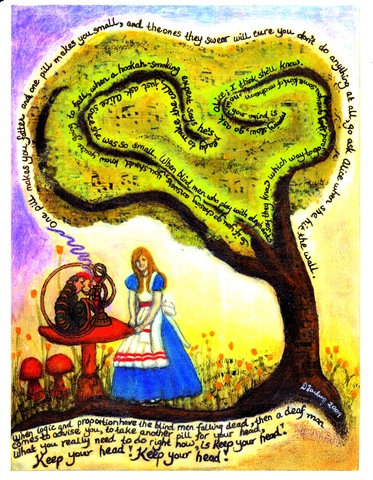
Ok, the “art and technique” of it all first.  This was done on 9” x 12” 120 lb cold-pressed watercolor paper in mixed media, with altered image transfer (only the hookah-smoking caterpillar) which I redrew and painted, so little of the original image was left intact, and the rest is entirely my original work.  The tree was sketched and painted on a page of sheet music printed in reverse (intentionally part of the theme), which was collaged on, then further refined with the rest of the composition.  This is the first time I have actually used this textured paper, mainly because I liked working on smooth paper with my other journal pages, but this paper was thicker and I needed something that could hold up to the heavy layers of media that I seem to apply, which had posed some difficulty with my previous pages, trying to put them on sheets of sketch paper (they buckled easily). 

I could stretch them on a frame or paint them on a stretched canvas to stabilize them, but I like to be able to have the pieces be more portable and the framing is too bulky for that.  I like to scan and print them at various stages of progress, too, as viewing the changes is also instructive about changes in my perspective and mental state, and anything much thicker than the painted page gets logistically difficult to manage with scanners & copiers & whatnot.  Media:  acrylic & watercolor paints, graphite, charcoal, soft pastel & colored pencils, lettering & outline in black micron pigma, gel pens in detailing & sig, finished with two coats of Golden Heavy Gloss Gel.  I have a bad habit of painting right up to the edges of the pages (I know, bad idea), and I’m working on that….sort of.  At least I keep promising myself to mask off the edges and stay inside those boundaries, but I’ve never been good at sticking to painting inside the lines, even though I now have to figure out how to put these oversized sheets into a bound journal.  I bought some 12” x 12” cardstock, to which I will mount these pages, then I can make  12” x 12” ring binder to serve for my growing collection of 9” x 12” originals.  Or maybe I’ll just get a scrapbooking journal with drop-in pages to hold them when they are not being displayed for some reason.  Ok, here’s the my art journal page:

Go Ask Alice 8.5 x 11

This is the story of my life , pretty much since I “got pushed through the looking glass” somewhere around 5 years of age (when I fell off a gymnasium head first onto solid concrete and cracked my head), up to, and including the present day.  I’ve been taken down more rabbit holes than I thought could happen in ten people’s lifetimes, and have been led down them by people who were entrusted with my care in one way or another–family, authority figures and, most of all, doctors and related professionals.  The latest and longest one (medical), I discovered on my own, due to a misdiagnosis by a negligent doctor almost 20 years ago, which has caused irreparable damage to my body, personal and professional reputation, and self-esteem.  What he prescribed, based on his misdiagnosis and what was accepted without question by every subsequent doctor, were his original diagnosis (which I have still not gotten hospital to remove from my record as inaccurate), and a long series of MANY drugs that I not only did not need, but I was allergic to each and every one of them.  I shudder to think how many times I probably came close to my own death without knowing it, when I was not doing better, so they just kept INCREASING the dosage, without ever using their professional expertise to actually try to understand if someone along the way might have actually gotten it wrong.  Yes, it is something that could actually have killed me.

While I am damned lucky that it didn’t, I’m struggling with moving past how that has impacted me, now that I know the truth, and what consequences are still ahead of me, not to mention the deep sense of betrayal with the majority of the medical profession.  I have lost count of the litany of surgeries that I have had to endure and the complications and permanent damage from those surgeries, all because someone screwed up a diagnosis, and scores of doctors to follow blindly followed that lead and made tons of wrong assumptions about what it meant.  I am actually the one who figured out what was actually wrong with me, and took action on my own (I stopped taking any of these kinds of medications completely) and declared that such drugs were off-limits for me ever again and that problem is now corrected in terms of taking those drugs.  The rest of it simply can’t be undone, and this journal is me processing those feelings.

The words on the page are a rewrite of the Jefferson Starship song, “White Rabbit,” and someone who knows me really well will understand my reference to the recurring theme in my own life of dealing with “the blind men and the elephant,” and the “deaf man” telling me to take another drug for my head.  Pretty much tells the whole story, and yes, “Alice” is a self-portrait.

Read Full Post »

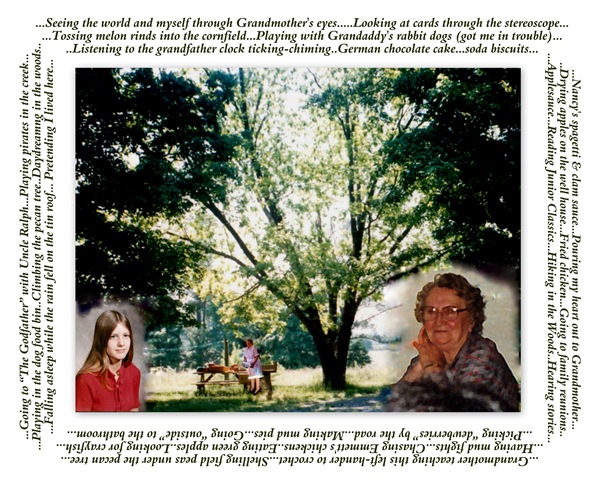
Family Bliss Journal 08.2009 4084x3272.2009 4084x3272

Some treasured memories from my childhood, and fodder for future art journals, since there are no pictures of most of these things, I will have to create them myself!  I was 12 years old in this pic and had just left home.  When my grandmother looked at me with the look she has in this picture, I knew that I was good enough in her eyes.  She was so peaceful!  I miss her!

Read Full Post »

Mood Journal 08.2009#3 4981x6847 5112x4088.2009 5112x4088

Another one that I’d been working on recently.  Too easy when things are tough in a family to forget the moments that we’ve enjoyed together.  As I was working on this, my first cousin died tragically, the circumstances of which underline the importance of remembering the goodness that you’ve shared together across generations.  This journal page cheers me up & makes me smile.  the tree in the main image is the pecan tree from my grandmother’s house, which really was literally the family tree for me, as so much of the good parts of my family life as a child took place in the vicinity of this tree.  It reminds me of so many important lessons that I eventually learned as a result of what took place around that tree, though it took decades in some cases for me to get the lesson.

Read Full Post »

scanned7-1

This is the 4th and final stage of this mood journal series.  Here, I have reached the conclusion that, as always before, I have always found solutions to the toughest problems that I have had to confront, and solution/resolution to the current problem will be found within me, as well.  Rather than looking for answers (illumination/strength) from outside, clearly I have the ability to come up with my own solutions that work for me, and I just need to focus on figuring that out by putting my energy there.

This final installment stands as a reminder to me of my own power to move these seemingly solid hard walls.  Historically, the tougher the problem that I have to solve, the more energized and focused I get, and the more powerful and amazing are the creative solutions that I develop.  While it may appear that I have been cut off at the knees (literally in this picture), and bound to stone structures that haven’t been moved in centuries.  Pretty compelling representation of (seemingly) impossible obstacles.  Yet, it is clear that, despite the current situation, that power comes from within, and all that I need still exists in me.  So now I simply need to gather the information and develop the action plan.  Removing the emotional obstacles (negative perceptions) is key.

I have developed one image that has the 4 stages together, because it helps me to clearly see the progression and transition:

Art Journal

I really like how much more effective this was for me, and I intend to do more.

Read Full Post »

Ok, so it was recommended to me, a “word” person, to try doing art journaling instead of a traditional word journal.  Given that I have never considered myself any kind of visual artist, the very concept was intimidating to me.  Heck, I’m left-handed, and I’ve always considered my handwriting to be so bad, that the idea of using that hand (or the other one or my feet) to try to represent what’s in my head sounded like a really BAD idea.  But there were reasons why I thought it was worth trying, and now I’m really glad that I did.

  1. I felt a need to journal, and to find a way to focus on what I’m thinking and feeling, really separate things and get, keep and/or restore perspective.  When I feel challenged, I needed a way to sort that out on my own, and not simply ruminate. 
  2. I had considered word journaling, but that really has never worked for me.  I have ADHD, and though I am really strong in the word department, I have difficulty really benefiting from journaling and sticking with it, and even after I’ve written a journal entry or 10, I lose them, don’t really look at them again, and the stuff that I’ve written kind of feels like it’s just disappeared somewhere and I forget about it, and I haven’t managed to keep a sense of benefit from the process aside from the mental dump at the time.  I kept losing the journals, and when I would later find them, very often my eyes would glaze over and I wouldn’t really connect unless there was something else motivating me to read a particular thing.  When I tried to write by hand, I couldn’t read my own writing.  When I do it on computer, it got filed and disappeared into the ethers.  If I printed it, I couldn’t remember where I stuck it. 
  3. But this art journaling thing has proven to be just the thing for me, and no one has been more surprised than me to discover how valuable a tool it has become for me.   The saying that a picture is worth 1000 words is even more true in art journaling, because I can look at ONE thing and get all that information and feeling that I put into it very quickly.  I can connect with a HUGE amount of information that I’ve shared with myself in a single image page, and I don’t have to wade through tons and tons of words that may be more difficult to hold my focus.  With the images, one sweep of my eyes catches my attention and what is represented in the pictures, and stimulates my memory and sometimes helps to remind me of solutions that are available to me in future situations, without taking a lot of time or energy to access that information again.  It’s like the image acts like a GPS for my brain!  Who knew?
  4. Because I do mixed media, combining various materials, methods, techniques, I can integrate anything I want into my journal–photographic images, images that I create myself, or use someone else’s images (with permission of course) into a page that conveys how I’m feeling, what I’m thinking about, or things that I want to remind myself about when I need those kinds of reminders. 
  5. Holding onto the journal entries isn’t a problem either, because they are visually appealing, and I can throw them right up on my walls!
  6. There’s something about the tactile aspect of the process of physically creating a representation of my thoughts/feelings in an art journal that really helps me to see myself from another perspective, and when I look at it, I know what the person who did that page was feeling, and I can examine it and decide what it means.  And the discoveries are not limited to just that moment, because looking back at earlier pages often makes me notice things that I hadn’t noticed before, such as progressions & transitions in how I think about something, or shifts in my moods, or little details that got poured into the art journal itself from my subconscious, but that I didn’t notice on a conscious level until later.  It would take me a long time to discover something similar if I was doing only word journals.
  7. It helps my husband to know and understand me better, as well.  He looks at my journal pages sometimes and better understands how I was feeling about something or that something was weighing on my mind differently than he had assumed.  Of course, I also write songs, and he being a musician himself, has observed things about some songs that I have written, that motivated him to ask me questions about what I meant.  Very cool to be able to give him ways to open dialogues with me and enrich our bond.
  8. The first journals that I’ve done now have within them ideas for future journals that I’d like to do!

I still don’t consider myself “an artist,” though I am pleased with my efforts.  My daughter and my mother are both artists, and I think they each have excellent talent, though they are very different as artists.  I accomplished what I was striving for—and more—so that makes it successful for me, to capture what I was feeling, chart the progression of my own thoughts and feelings, and through basically 4 stages, arrived somewhere that I was able to get through the journaling process.  It was actually quite a surprise how effective this was for me!  I am also pleased from an aesthetic standpoint with the outcome, as I find all of the stages pleasing to look at, as well.

Here’s Stage 1:

Here, this is a self-portrait, and at the time, I was feeling a bit disconnected, and unclear about how I was feeling about something pretty important.  What was bothering me Mood Journal 08.2009#1 4981x6847.2009#1 4981x6847was feeling “yucky” but not having clarity around what was going on with me, and that bothered me.  I began this series to sort out my own mind, and this is where I started.  It’s a curious process, having a pen or paintbrush in hand, with me being so unfamiliar with doing these kinds of manipulations, to be forced to develop skills to accomplish the task, using my hands.  Yet, I think that this was a key element to why it worked well.  I was forced to try to represent things that already felt unclear to me, in a form that was unfamiliar to me, using parts of my body (eyes & hands) in ways that I’ve never done before, and I didn’t have a clue how to start.  This kind of scenario would have been a classic dilemma for me in the past, yet in this instance, I somehow knew intuitively that I needed to do exactly this, and there was an unexpected sense of urgency about it for me.

Staring a a big white piece of paper without a plan for what I was going to do or how I would do it was daunting, to say the least.  I felt extremely reluctant to start to put anything on that paper.  What should my feelings look like?  What should I look like sitting with them?  What should the context look like?  Once I stopped worrying about deciding everything in advance, and just to go with my gut, I accepted that there was no right or wrong to this process.  What was important was DOING it.  It didn’t matter how it looked or how the materials worked, so long as I represented as accurately as I could, what/how I was feeling and/or what my thoughts were.  I feel that I accomplished this, and more effectively than I ever have with any form of journaling or lettering before.

More to follow…

Read Full Post »

« Newer Posts

Tasha Miller Griffith

Sustainability and Belonging through Textiles

The Baggage Handler

I made the impossible easy in both worlds!

prophetbrahmarishi

Just another WordPress.com site

Love. Life.

It's simple, yet powerful.

Life is but a dream!

Wisdom from all around the world.

Bucket List Publications

Indulge- Travel, Adventure, & New Experiences

Abandoned Kansai

All abandoned: Chernobyl / Pripyat, Nara Dreamland, Anti-Zombie Fortress, Japanese Sex Museum - and many, many more! Plus: North Korea Special - 2 trips, 16 days / 14 nights! As seen on CNN...

Break Room Stories

Service Industry Stories and More Since 2012

Sumthin' Creative

Just another WordPress.com weblog

LornaPhone

Visual essays for a digital world

My Life Disconnected

adventures in a disturbed mind

Kay Solo

I suck at writing taglines.

MesAyah

Melodic hiphop meets deep reflections about life and death

Window to the Diamond

A Blog by Betty Rogers

C.B. Wentworth

Just following my muse . . .

The Rag Tree

poems, essays, encouragement