Feeds:
Posts
Comments

Archive for the ‘art blog’ Category

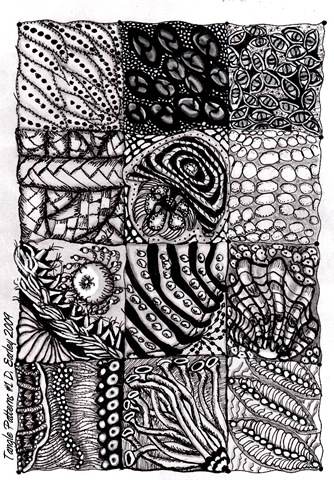
Tangle Patterns #1

I’ve mentioned in previous blogs how helpful it can be do doodle when I’m not feeling well.  One of the activities that I’ve been working on was putting my doodle patterns into a notebook for me to flip through when I am thinking about doing fills in drawings and looking for ideas about patterns that I might want to use, and so I’ve been working on these zentangle pattern sheets with my own pattern designs.   The pattern template itself, is a 12-block blank grid that Milliande put together. 


Think of these as doodle patterns that I might use to incorporate into images.  The sheets that I drew them on are standard 8.5” x 11” paper, done in black pen and shaded with graphite pencils, all on the same sheet of paper that you see here.  This is just standard photocopy paper, so it was not doing to take a lot of wear and tear, but now I will transfer the completed pattern sheets to some sturdier stock, and hold onto the originals.  Each pattern was drawn for the first time on this sheet, and was completely unplanned—a bit terrifying, since I was doing them in pen, I tried not to think about what would happen if one of them didn’t work, since I had no “do-overs”!  Think of these as design idea sheets for me to reference, of patterns that I developed before, to give me some ideas for new drawings that I might want to do.  Some of these designs have pet names.  I might update this blog later with the pattern names. 


tangle patterns #2 dearley

Much of the detail lines are done with a Staedtler 0.1 pigment liner, which is the finest pen size that I’ve been able to find.  I had to do these drawings using both my reading glasses and my large magnifying task light, and my eyes are still killing me!  Ugh! 


Read Full Post »

IMG000049 Some days I don’t really have energy to do much of anything, and it affects my creativity and also my positivity to navigate my way through the day’s challenges, whatever they may be. I am posting a list of tips that I will update as I think of/discover additional tips for boosting energy. 

This first list is derived from one that MSN had recently posted via Redbook Magazine, called “12 Surprising Things That Are Making You Tired.”

  • Have I taken a pleasure break lately?  Read jokes, share them with others, flip through a magazine, call a friend, daydream, doodle, waste time, play a game, play a CD while you’re doing routine tasks.  Mini-breaks will make your time more “ho” than “hum.”
  • Have I had my light boost today?—get outside for a 10-minute walk of some kind at least once during the day or when you’re most tired—bright light has a caffeine-like power to make you more alert. Even if it’s cloudy, you get more light exposure than sitting in your studio or office. If getting out isn’t an option, at least try to spend a few minutes in a room with lots of natural light, and if that isn’t possible, use natural spectrum lighting in your workspace.  Some people get the seasonal blues and blas when the days get shorter and they are outdoors less. 
  • Am I Breathing?  breathe from your diaphragm several times each day—when you’re feeling tired or you’re about to go into an energy-draining situation. Put your hand over your belly button. As you inhale, focus on making your stomach and chest move. This will automatically expand your lower lungs so you take in more air with each breath.  The increase in blood oxygen is rapid and the energy boost and relaxation enhancement is significant.
  • Have I Moved Lately?  Doesn’t have to be dramatic to work. At the gym, I had a 5 minute promise to myself to HAVE TO spend only 5 minutes exercising, and if I didn’t feel like doing more,I could stop.  Before I hit 3 minutes, I was always energized and motivate to continue.  The 5-minute rule has changed for me during flare periods, with so many co-morbid illnesses that fight with each other, but even then, I can do what I can to stretch, walk wherever I can, even yawn (with the whole body). Even striding to the bathroom. When I feel better, I try to break up long periods of immobility and concentration on a project with little breaks to keep my body alert. I’ve found that with doing detailed art, intensive research, and concentrating on a project, being in the flow, I lose track of time, but my body feels some effect from long uninterrupted periods without much body movement, and my eyes become strained when I don’t change my focus periodically.  So I try to look off into some sort of distant point about every 30 minutes or so to give those muscles a rest. Feelings of eyestrain can bring the whole body down into a state of fatigue and strain.  If a long involved project has left me with severe eyestrain, I may need to take a break for hours or days and do something else for a while that gives my eyes a little more rest, and come back to it when they feel better. 
  • How is my sleep hygiene?  It is important for me to try to go to sleep as close to the same time each night as possible, and wake up around the same time, to keep sleep cycles stable.  This is less stressful and fatiguing on my body, and enables it to cycle more efficiently. Lack of good restorative sleep is probably my biggest aggravator of uncomfortable physical symptoms and stress, which drains energy, and makes it more difficult for my mind to shift into a creative and relaxed flow.  Flares, for me, are both an indicator and a cause of sleep interference, so when I am having them, it is even more important for me to pay special attention to getting myself to sleep on my schedule the best that I can, and to eliminate anything in my environment that may interfere with that, such as caffeine, worrying about stuff, clean & comfortable sleep atmosphere (clean room, fresh air, humidity, clean air filters, no noise or late night TV), avoid stimulating activities just before bedtime (TV, work, exercise, arguments & other stressful things), wind down period, avoid daytime naps. And make sure to dim the lights leading up to bedtime, to get your brain shifting into the sleep mode (the opposite of “lighten up” above).
  • Am I getting enough water?  By the time you’re feeling thirsty, you are already somewhat dehydrated, and your heart has to pump harder to circulate blood and get oxygen and nutrients to your brain, so your energy drops.  9-12 glasses of water a day, depending on how sedentary you are and the environment.  Fresh fruit and vegetables have very high water content (as much as 90% and more) in an optimal form for absorption by the body, so use these when a bottle of water isn’t within reach.
  • Did I eat a healthy breakfast?  Usually the answer for me is no, but it matters.  Eat a healthy breakfast—make sure there is good quality protein and long-acting complex carbs.  I’m bad on this one, just because I am almost NEVER hungry, and food is hard for me to handle anytime, as eating easily sets off problems for me rather rapidly. Two things that I currently do ok with, is part of a chewy TLC bar by Kashi (my favorite is the Trail Mix bar). Each 140 calorie bar contains 6g protein, 20 grams carbs w/4 g fiber,and 0 trans fat, and the 5g fat comes from nuts & grains.  I used to do well with oatmeal, but the last 2 times I tried that didn’t go well; not sure why.  Probably because I don’t eat often enough.  I can also handle limited quantities of fresh fruit, and protein powder, and I should at least get in a protein shake made with fresh fruit and a scoop of protein powder, to get me going with 20 g protein plus some fiber & carbs.  Raw veggies & raw fish (sushi/sashimi) generally always are ok to my gut, but not exactly the breakfast of choice!
  • How’s my posture? Check my posture and body language—if I’m slouching a lot, energy isn’t flowing properly.  Change positions, straighten up, pay attention to ergonomics in my environment that may be creating chronic stressors and setting me up for some sort of repetitive injuries (i.e., carpel tunnel syndrome) that will drag me down.
  • Get away from noise.  Noisy environments can be draining to cope with.  Bring down the volume when you can on noise.  It’s ok to play stimulating music for exercise, but control what you can of interfering extraneous noise.  I personally enjoy the morning hours, sometimes most of the day, with virtual silence, since my ADHD is managed effectively now, I really cherish the quiet.  Before the ADHD was being managed, I used to work in a really noisy loud environment as it seemed to somewhat dampen the constant noise and clutter in my head.  I don’t know why it worked, but playing bagpipe music at maximum volume on headphones was the only thing that managed to drown out the noise in my head and enable me to focus enough to get through law school papers & exams.  After 49 years of perpetual noise, movement, and chaos, it is almost shocking to a lot of people at how quiet and still I prefer to be a lot of the time.  But it’s so peaceful now, and I don’t like to disturb that precious calm.  When I have to be around much noise for long, I get tired quickly, and look for somewhere quiet to escape to.  I don’t so much find the noise to be distracting now, as irritating.  It’s like screeching chalk across a blackboard for me now, and it feels like a roadblock to my flow.

    If I am trying to do something creative, and having difficulty shifting into flow, the very first thing I have to do is to quiet and still my mind—to bring it down to a state of openness to flow.  If I am having a flare, I have to do exactly the same thing before I can begin to be able to use creative activity to manage pain effectively and get through the flare with the least impact, but I am starting even farther away from a flow state when I am in a flare.  At that time, my entire body is more sensitized to every kind of external stimulation—light, noise, smell, taste, touch—they all increase pain and spasms—so it may be necessary to go to a quieter room, what I might call a “clean room” that is as devoid of harsh sensory stimulation as possible, to get my mind in the right condition to shift into flow and access positive energy.

Read Full Post »

So I’m participating in The Sketchbook Project, which means that I will complete an art journal that will be a part of a traveling exhibit before moving to a permanent collection next year.  It’s very exciting, but also a little bit daunting.  I’ve been assigned the theme:  “How to Save the World".”  So I am going to be posting to this blog and updating it with thoughts about my pages, and looking for ideas/inspiration on the theme.  I have thought of a few topic ideas for my pages already, and would do pages around any of these ideas from the list below, that reflect my vision of what we all could do, to save the world:

  • Organize a WORLD COLOR DAY: set up network & internet coverage that can be captured and sent by anyone via camera phones, email, live webcam feeds, and global news organizations.   Anyone in the world who is willing and able should color pages, and people in leadership positions should be obligated to participate, especially political/government leaders:  everyone can choose from a collection of various coloring pages (can be shapes/designs like patterned mandalas or still life pictures, or line art illustrations). Embellishment of the pages is entirely at the user’s discretion.  This enables us to “see” one another through use of color, rather than the color of our skin, hair,etc. It is a common language, regardless of the language that we speak, and does not require special skill or elaborate materials.  Color may be applied with anything from crayons, paint, pencils, to grass, food, soil, makeup.  Anything goes, as long as the paper can hold it.  Coloring is very calming, enhances health, and problem-solving abilities.  It would help the human race, to build bridges through individual expression–without judgment or criticism–and enable people to not be burdened and divided by cultural differences.  
  • Raise children to see differences among people as “interesting,” not bad.  Role models: “walk the walk” 
  • Be mindful that every choice that you make has consequences somewhere, somehow, and/or to someone or something.  Doing nothing is a choice, too.
  • Stand for something that demonstrates the best aspects of your character.  The way you live reveals what it is that you stand for.
  • Forgiving others relieves YOU of the burden of YOUR anger.  Save yourself and the world at the same time.
  • Treat all humans with dignity, respect, and compassion.
  • Practice mindfulness.
  • Permit the innocent to speak of harm done to them by others without inflicting a sense of personal shame on them.  However unpleasant it may be to hear about their abuse and pain, they were victims, and the first-hand experience was undoubtedly at least as unpleasant for them.
  • With power comes responsibility—do your very best to take responsibility
  • Challenge negative assumptions about others and ourselves; acting on negative assumptions generally yields negative results
  • Hope is not a strategy—start from where you are, and act according to your ability.
  • Don’t waste or destroy, just because you can.
  • Always question the source and validity of strong feelings of judgment, anger, sweeping generalizations and prejudice.
  • The value of a gift is not measured in quantity or money or scope, but in the true generosity of spirit, purity of intention, and ability to give of oneself

Read Full Post »


Greater Than the Sum of My PartsWell, today I did feel better, and I did go back and finish this image, as I saw it in my mind’s eye.   I like this picture very much, as well, it tells a story.  But the other picture, well, it IS a story, and they are both wonderful parts of the (w)hole that is me!  This was done in graphite, colored pencil, pens, and markers.  I feel glad about both of them!

Read Full Post »

what not to do in pain management"Doctor, it hurts when I do this." "Well," the doctor says, "stop doing that."


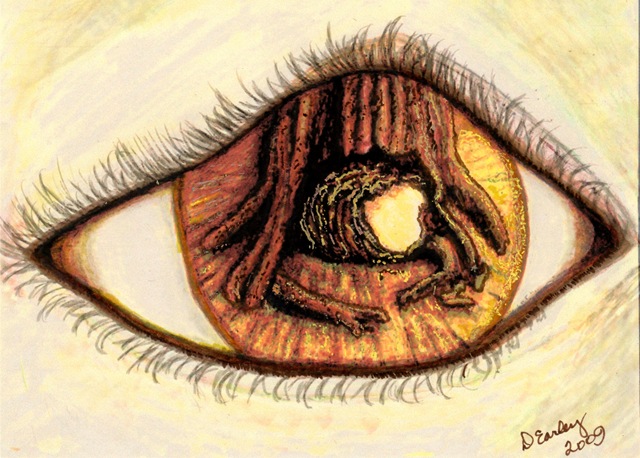
Yesterday afternoon, I formed an intention to do a drawing as part of an art challenge in a terrific online community of women artists called Milliande Art Community around the theme of “holes”.  My intention was to do a drawing incorporating the holes as a concept and I had a few options for compositions that I thought would be fun and aesthetically pleasing, and intended to share the finished piece with the group. At the time I was feeling pretty good, low pain, plenty of energy, and excited about doing some art just for the joy of creating.  My mind was already in a creative flow around it, and I looked forward to drawing it up.  Well, here’s the drawing.  One can debate about whether it is finished or not, and reasonable minds may disagree about just how aesthetically pleasing this drawing is at this point either.  Assuming that throwing my sketchbook across the room in frustration and hoping to never look at it again constitutes “finished,” when I “finished” last night, nothing about it felt good for me.  In fact, I was completely frustrated and stressed throughout the entire effort, from the moment I began to look at the  sketchbook page and trying to imagine the composition on the page, to drawing, to the moment that I threw it aside in frustration.  The whole effort felt like failure to me, and I hated feeling that way.  Before I went to sleep, I remember thinking that I should just get up in the morning, and rip the page out, throw it away, and completely start over.

But after a fitful night of sleep and a little distance from last night’s frustration, sitting quietly in the gentle light of dawn this morning I was better able to reflect on what had transpired, and this yielded some clarity for me.  I am constantly reminded that we only actually fail if we have learned nothing from our “perceived” failures, and I was reminded of this again today!  I think I understand now why it is that this didn’t work for me, and what might have worked better, whether it be art or other tools that I am trying to use to enrich my life.  The key for me is recognizing that there are distinctly different processes that are appropriate to working with where/how I am at any given time, and the key is recognizing what condition I am in, starting from there, and using what works.  Instead, last night I tried to force reality to fit a specified process, rather than the other way around.  The resulting product was a bunch of media forced destructively onto paper, that in no way reflected the way an image had been in my mind earlier in the day, and the more I tried to “fix” it, the farther away from that image it became, and the more upset I became.  Instead, the image that evolved on the paper was me holding up a mirror to myself, and I was stubbornly refusing to see it until this morning.  There was no flow of inspiration; there was only fight, because at the time I did not recognize a very important fundamental truth:  My journey can only begin where I am, and it can only go where I take it.  Force of will of my “thinking” brain cannot alter this fact; resistance is futile! 

So what went so awry?  In contrast to earlier that day, by the time that I began working on this, I was in a high state of pain and serious distress, almost completely horizontal, with physical discomfort that prevented me from even carrying on a conversation.  But rather than start from how I was at the time and modify my process accordingly, I kept trying to forge ahead as if my mind were already relaxed and comfortable, already shifted into creative flow, rather than allowing myself to become calm, quiet my mind and gently allow things to open up and flow naturally.  Instead, I added stress and discomfort through critical thinking, controlling behavior, and placing unrealistic demands on my mind and body.  The result:  the demands of my “thinking” brain did influence the product, but not as intended.  But the journey went exactly where I took it, and where I took it was where I was capable of taking it, given my stubborn insistence on trying to adhere to a process that was entirely unrealistic.  My husband often says, “You just can’t go any faster than the car in front of you,” and he’s quite right.  It just took a while for my brain to realize that it was acting like a road-raging tailgater on a one-lane road behind the rest of me—not exactly a great strategy!

Having said that, I did actually succeed in incorporating holes into this image—in more ways than one.  I managed to dig very deep scratches into the thin paper, especially throughout the hole at the base of the tree that is also the pupil of the eye.  You see, as my “road rage” escalated,  I dug deeper into the paper with the pencils.  And this little drama that played itself out last night reveals the theme of holes, as well.  It showed me “holes” in my own thought processes, and in fact is a real metaphor for experiences that I’ve had in my larger life, as I have fallen into similar holes in other ways, using a similar strategy.  Food for thought! 

And as I look at the picture today, with a clearer head, it’s not as “bad” as it seemed to me last night, shredded paper and all.  In fact, it does show the beginnings of what I envisioned, and if I wanted to, I could probably transfer the existing image to some fresh paper and work from there.  If I want to.  We’ll see.  But no matter how a “new and improved” image might turn out, I think that this one is a keeper after all, because I believe that it has real value just the way it is.  When I think about it, notwithstanding the unrealistic demands of my “thinking” brain, it is clear that I began where I was at the time, that the journey went exactly where I took it based on constraints that I chose, and I learned something valuable from the experience.  For me, no matter how aesthetically pleasing or displeasing the image may seem to me or anyone else, this means to me that the journey was a successful one!

Read Full Post »


This Is What I Had In Mind

So I hope I’m coming off a 2+ day flare (fingers crossed), and yesterday was really yucky, so I drew this last night in my 5”x7” sketchbook that I doodle in at bedtime, and yes, those are some tiiiiiiiiny lines!  I added the color this morning just for fun.  I’ve been working on a post to describe some options for accessing the power of your brain to improve pain, stress, and other discomforts, with references to the experts in the relevant fields, and links to more info, but the flare sidetracked me (can’t do words or critical thinking when flaring and trying to manage without meds), but still had the brain in the back of my mind, so I just went with it and let the flow just go with whatever came to mind.  As you can see, I have doodled this freely, and used a brain sort of outline to frame the doodling.  And, of course, whatever ended up in that frame was what spontaneously flowed out of my mind, with no plan whatsoever.  I really think that zentangles like this work best for me when I’m in a lot of pain, and they give me so much enjoyment, as well!  And while I’m actually doing them, my perceived pain levels are minimal for large chunks of time.  I’ve been told that the more I practice this during pain periods, the more effective it will be for me, and the easier it will be to tap into this powerful strength of the brain!  I’ve already seen improvement since I began doing this just over the last few weeks.

This was done in graphite, pens, markers, colored pencils.

Read Full Post »

focus on pain doesn't help 102509

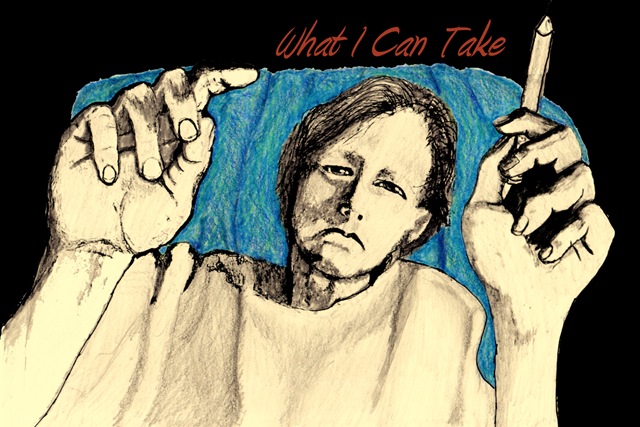
This is me, in pain, yesterday, in fact, and when I’m in pain, this is where I have to start to manage it, and this is what I can take, literally and figuratively.  Can’t take pills for pain, so I have 3 things at my disposal:  my two hands (to the extent that they are working that day) and my brain to manage pain and plug into a creative flow that can help me to not focus on the pain.  I post what I draw to manage pain, but thought it was important to also document where I have to come from to use art in pain management, and this is an actual portrait of me in the throes of a nasty flair.  I think the face tells the whole story.  I sketched this from photos that I took yesterday with my webcam during a bad pain episode, just before I started drawing.  My husband says this is excruciatingly accurate; it certainly *feels* right.


Pain Isn't Pretty I can sometimes draw some cool things at these times, but no, pain is NOT pretty, and it doesn’t feel pretty—AT ALL. I’m just grateful to be able to do something to get through it.  It was disturbing to even draw this, because I don’t like to focus on the downside.  I don’t want to do this very often, but it’s important to me to document the painful reality that is my starting point.  I think it’s clear that I was not in a good place, and not letting pain beat me is essential.  If I can start from right here and DO something to get through this, I can “take” anything, even if I can’t TAKE anything for the pain, and I can get through it.  Keeping my pencil sharp for what comes next….

Read Full Post »

Come Fly With Me If you’ve read my early blog posts here, you know that I started art journaling as a form of therapy to deal with the emotional impact of “stuff happening”, like the onset of one illness or permanent surgical complication after another, that have left me permanently and severely physically debilitated.  A far cry from the body builder/singer-songwriter/can-do-anything person from the not-so-distant past!  I had a dynamic and brilliant career in the corporate world, picked as a “Top Talent” in the company, positioned to soar, and a true innovator.  And though I bravely fought back every time the flesh took me down, and returned to deliver even more amazing solutions to the company’s problems than before I’d left, one extended medical leave after another chipped away at the potential that was seen in me, and the periodic ravages to my body were stripping away my ability to do a job with any degree of consistency or predictability. 

In the last year, that has taken me down to the point where I spend large chunks of my day in bed or in a recliner, recovering between physical efforts, or riding out flares of pain, nausea, and muscle spasms.  I often need help with daily living functions like dressing myself and preparing meals.  I am quite literally deathly intolerant of pretty much all “mood management” medications for reasons that doctors have only been able to speculate about, the leading theory being multiple brain traumas.  Which means, of course, that if I become depressed, I cannot simply take Prozac or some other antidepressant and shake it off.  So I explored art journaling to keep my head together and to keep me from falling into depression or chronic anxiety patterns.  This has been far more effective than I’d ever imagined.

But there is more to cope with besides the emotional impact, and I live with chronic pain, nausea, and muscle spasms on a daily basis though in varying degrees of severity.  My medication intolerance extends to medications that control pain, muscle spasms and inflammation, as well.  So how does one manage these things without meds, when exercise is also not a realistic option at these times?  How does one experience a satisfying quality of life, and limit suffering under these conditions?  Since my philosophy about most things in life is that there are always options in tackling most every problem (maybe not all of them are desirable), my challenge has been to discover/develop solutions that could enable me to get through the bad spells, minimize stress responses that would aggravate them further, and find a way to “feel good” when my body doesn’t.  Many tell me that it is difficult to even imagine that I would be able to do anything more than just try to get life over with. 

But the thing is, that has never been me, or how I choose to experience life, and “there’s nothing you can do about it” has never impressed me as a life strategy.  I’ve heard stories of people who can walk on fire, sleep on beds of nails, do great things during times of extraordinary pain and devastation, without drugs or external help, in fact, with only the power of their minds at their disposal.  How do they do that?  What is the process to change how the brain functions, as needed, to control perception and filter out certain things while allowing other processes to happen?  I don’t pretend to have all of the answers; I am only beginning to discover bits of it through what works and doesn’t work for me.

So let’s look at how this process works for me, just using yesterday as an example.  Yesterday was another heavy pain day, so I had to come up with something to do that could push my brain away from pain focus and help me to be comfortable riding out the pain.  The challenge at these times is that I am well into the pain portion before it registers that I can’t simply ignore it by force of will, and it is so compelling that at that point, I’m not capable of choosing complex thoughts or organizing myself to do something in a linear, left-brain fashion.  I know that if I can access right-brain “flow” creative processing, I can get myself more comfortable while whatever is happening runs its course.  Watching TV only seems to exacerbate things—too much movement and noise–, and carrying on a conversation, or doing any kind of critical thinking or mental organization is too exhausting to try to start at this point.  I hit overwhelm easily and the next thing I know, the pain is escalating and I’m losing it, start crying, body tenses up, and I’m toast till I pass out from it.  Starting some emotionally intense art journal page is not a realistic option because the stress zone is not a good place to be while in this state.

Enter the doodle.  Given that I’m already in the pain zone, not in “flow-space”, making creative decisions of any complexity and other problem solving is out of the question.  I couldn’t even think of what to doodle, much less where to start.  So I printed off a freebie foot stencil that is used for spray painting, and thought I’d just doodle in that.  footprint-stencilNo critical thinking or real problem solving required.

So the conversation in my head at this point goes something like this:  “Ok, this should be pretty simple.  Focus on these simple lines, sure, I will try this.”  Pens are right by my chair, along with a cheap dollar store notepad that I use for doodling.  But as I looked at that foot stencil, and tried to make a decision about where to put a line, it occurred to me that this foot seemed too flat and was a little boring.  “What if I instead did it in a 3/4 view of the bottom of a foot, but what does that actually look like?  I don’t sit and stare at foot bottoms all day, or really, ever.  Oh wait, let me look at the bottom of my own foot, which, since I’m in a recliner in my pajamas, is actually easy to do!”  As I looked at this 3/4 view of my foot, I noticed the hills, valleys, angles, shadows, and interesting perspective, and I just started drawing.  How strange a subject, I thought, yet how fascinating it actually is!  Now, I was in the flow!

I started mapping out sections to isolate for patterns, like pieces of a puzzle, such as the bottom of the heel,  toes, ball of the foot, arch, etc., each of which had shape to play with dimensionally, and I laid in fun patterns in each, then I started applying shading and color with pens, just whatever felt good and flowed out of me.  As the flare raged on, I kept drawing and coloring, and adding layers of doodles, feeling good as long as I remained plugged into that flow, and creativity continued to expand and the drawing became increasingly more complex.  A couple of times I had to stop what I was doing, and focus on something else, like helping with some household organizational thing, or answering questions, which pulls me completely away from this mental state.  When this would happen, the pain would drift back into the body, not immediately, but gradually, and I would get the point where I had to cut it off and shift back to the doodle before the pain took over completely.  And so went my afternoon and evening.

Eventually, I finished that little zentangle, and scanned it into my computer, and here’s how it looks:

Put My Foot In It Again 

Fascinating what the brain can do when one can open up the flow state!  This is the exact angle of my foot as I looked at it, and the perspective is right.  Bizarre, yes, but I’m ok with that.  But wait, there’s more!  I started spinning this around on my computer, and chopping it up and combining the patterns (still in the flow), and I started to see other images in the patterns when manipulated. 

I saw the beginnings of a really cool moth, once I fused pieces of the image together, so I took these fused pieces, printed off this new image foundation, and drew the rest of it and shaded and colored it, and arrived at a new image:
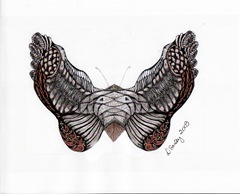
Come Fly With Me

This one I really love!  The furry details in the body and wings, the tail, the way parts of the body seem to dip and others move up or away, all so dynamic and fun!  If that were a giant moth, I could see myself riding on its back to some magical destination.  And it’s clear that it is intricately detailed and elaborate, yet there is no way that I could have chosen to design this piece in the state of pain that I was in, which is the importance of the process of starting with something that I could wrap my brain around, like the stencil above.  I’m not a neurobiologist, so I don’t know if pain stimuli that are floating around in my body are experienced on any level by me, or to what extent they influence what is going on in the flow part of my brain, but I do know that just because I am in a flow state doesn’t mean that those parts of my brain aren’t functioning; they are, however, in a relaxed state, and are running more on a kind of autopilot.  They may influence the art in some way, but my subjective experience, at least, is one of relaxation, pleasure, creativity, and the resulting output gives me pleasure beyond the doing!  And the ravages of the body are meanwhile doing what they do, and I, at least, have done a very good thing to help my body with that by keeping the body as relaxed as possible while the flares run their course.

Summing up the process: when I find that I’m in severe pain or discomfort, I find something simple to look at and manipulate, and create an intention only to make marks of whatever kind arise spontaneously, no plan, no criticism, just make marks, doodle, make squiggles, doesn’t matter what, just the doing.  If my creative brain kicks in, it will create what it chooses and it will be fine.  If I fall asleep in mid-squiggle, that is fine, too, because the relaxation allowed my body to choose what it would do without the interference of my stress responses.  If I get energized around the doodling, flow has taken over, and I’m on my way to wherever the flow ride takes me.

Read Full Post »
water colors 3

water world distort1

Just a couple of pieces that spun off the colors in Water World so far.  I already have plans and ideas for them!  I love these colors!


Read Full Post »

sg0010-1

Ok, technical first from this newbie, as yet imbued with more passion than skill but learning:  

Now you can start to see detailing added, though this is *very* far from complete.  I needed to enlarge the image to get the intricate detailing built up in layers, and you are starting to see that begin to take shape in the main image here.  My scanner isn’t big enough to accommodate the entire picture now (which is currently around 10.5” x 16” in size vs the original 9” x 12”), which has been laser copied onto heavy cardstock.  Already, the limitations of the new substrate & laser copy  versus the original substrate have presented my first challenges from a mixed media standpoint in developing the image.  The first journal (“Turn On the Light”), I would get a little freaked out when I looked at the state of each stage as I was doing it, seeing changes come into it that felt out of control, and moved me seemingly away from the image that was growing in my mind, and I would worry at stages that I had ruined the vision, but watching some of the instructional videos that you can find online  or instructional articles by artists, such as Milliande, DJ Pettitt, Mysty Mawn, Pam Carriker, and Willowing, just to name a few (look for them on YouTube & elsewhere) who demonstrate working with layers, and seeing all of the evolutions, devolutions, and gradual building up of layers to arrive at their rich final images, full of depth and character, I would see interim layers that temporarily appeared to me to be digressions from the image they were after, until I saw the importance of those interim layers in the cumulative final image.  In the image to the left, for example, at this stage, the face lacks much detail and depth, and appears that the colors are a bit flat and incomplete, and much more harsh than the final image will be, but that’s ok, because it’s still being developed and this will ultimately contribute to the depth and dimension of the final image.  This is only 1 stage in the layering process, that will probably ultimately consist of 7 or more layers before it’s finished, and each subsequent layer will have significant changes from the previous image, just as this one does from Stages 1 (a & b).  That is all part of this process in  multi-media sense.

I already am battling small challenges with the media,though I am learning, and don’t get as frustrated as I become more familiar with how they behave with one another.  This is the complexity of working with mixed media, it’s like taking a whole lot of different prescriptions meds:  you not only have to be concerned with how a particular medication might act in your system, but how it interacts with everything else in your system, as well.  Same for mixed media, and depending on your depth of understanding all of the various media & substrates, etc., and the changes in those elements over time, this can prove to be an endless learning process.  I now had comparatively limited tooth for what I would have preferred to do with only graphite and colored pencils at this point, with some watercolor washes before moving over heavily into acrylic (which has been problematic to work with dry media later), so I try to get that bit down first before beginning to build up layers of acrylic.  However, this didn’t work so well on this slick sealed laser printed surface.  Even graphite didn’t adhere well to this surface, but softer graphite, like a B/HB was at least sufficient for me to get the scales drawn out which I then burnished in with yellow Prismacolor pencil (cadmium yellow), and I “washed” some scarlet red watercolor pencil over that, which settled down rather nicely into the grooves created by the burnishing of the gold.  I do like the 3D effect that the burnishing had on working with this new substrate.  I had them do the copy onto the heaviest cardstock that they had in this size, which is somewhere between poster board and matte board in weight and consistency, so burnishing left definite physical grooves in the substrate to good effect.  Although the laser print is at least not a glossy finish, the matte finish afforded me little improvement in applying dry media, but no matter.  I’ll make it work eventually.  I just want to be able to build up at least some thin transparent layers to give it depth and enhance a feeling that it is all floating within a watery environment, and to give it more dimension, and therefore portions of details of the image I am trying to get down on this first level.  Ultimately, I will use clear acrylic media to restore some tooth (I’m thinking at least one layer of matte medium or clear gesso at some points for tooth, an another of acrylic ground for pastels to bring in washes, and then later some glazes).  I will need to do an image transfer to lift this image off this surface, and sandwich it on top of another somewhat transparent layer of acrylic medium, probably one of the gel mediums, and adhere that to the permanent substrate, which I’m thinking will be a heavy watercolor paper.  I know I should probably go with canvas, but I resist because I still like to carry these in a big book to protect them and enjoy them at my leisure.

I used a white galaxy marker to bring some semi-opaque white over some areas to expand the gessoed portions of the 2nd layer (mermaid) juxtaposed on top of the background scene.  What I like about the Galaxy marker is both the opaqueness, and that it lacks the gloss, thickness and resistance that the other opaque marker options would have left, like the Deco Paint Markers or gel pens.  As I think about this, I guess another option would have been something like Staz-On Ink pad & brush.  I used it anywhere that I wanted to be able to bring some opaque white that had the potential to blend with either the laser inks subtly, as well as whatever I wanted to add next, prior to shifting over to mostly acrylic.  You can see this in the softening of the blue skin tones, and building out the fins, and I also hit each scale with a little bit of the white marker to add a layer of dimension and further enhance the impression that the scales are more concave and the light hits them more toward the centers where they stand out more, versus the valleys around the scales.  There will be some adjustment to this concept in a subsequent stage, as the tips of some scales overlap adjacent scales a bit, which will be developed in subsequent stages as it gets further refined. 

In the hair strokes, in addition to selective application of Deco Paint marker to lay out some specific whisps of hair, I have also used the Galaxy pen along with water soluble oil pastels to bring in a bit more blue/green into the hair as well.  My reservations about using the Deco Paint markers at this stage are that they have Xylon in them which is smelly, but more importantly, can dissolve the inks from the laser printing if I’m not careful, and I didn’t want to obliterate the lovely background that should show through bits of her flowing hair, at least not yet.  Lots more detailing and shading to come in subsequent layers on this mermaid, and there will be a story about this image, as well, which I will reserve until I have finished. 

To try to tell it now, as I see it would be incomplete at best, and possibly not very accurate, because my mind tends not to reveal everything of what this is about even to me, very often, not until some time after I have completed the piece, though by the end, and perhaps after a night or two of reflection on the completed piece, I usually have a mostly complete understanding of what my mind was trying to tell me.  This is a really funny thing about this process of art journaling and art therapy, because it opens up a kind of dialogue with your subconscious that gives you more direct access to what’s going on over there, though the way that I am able to achieve this kind of communication is unlike what happens on a conscious level or in a physical conversation with another person.  The hardest part for me, who has relied heavily on left brain working independently to tell me what I am thinking and feeling, is developing a process that is really about letting go of controlling my mind, and letting the other part of my brain drive the bus, and wait for it to reveal itself to me through this process.  But as new and unfamiliar as this was at first, regularly practicing it has shown me that it works, and I am growing my skill at increasing left-right brain integration, which is taking my mental capabilities far beyond what they were, not to mention pulling the pieces of me together, which I really need right now to deal with my challenges.

What I will tell you at this point about the story is that when I started it, as is often the case, an image began to form in my mind, or, I should say, portions of an image, each portion out of context, that seemed like whimsical images, that were just fun and relaxing to draw and explore.

There are a number of physical imperatives/impediments to art for me that affects how and when I do art.  The way I started this piece was really just to help me keep my mind off pain to keep me as calm and relaxed as possible, while my body was riding out a 5-day stretch of very nasty flares.  For those of you who have given birth to children, my experience is somewhat akin to labor and delivery, though it happens on a much more regular basis.  The art keeps me from getting overwhelmed with the waves of pain and gut upheavals that come with the flares, since there is no medication to manage the pain or spasms that is safe for me to take, so I have only what I can do with my mental state (biofeedback and constant attitude adjustments), and physical manipulations (massage, gentle walks, hot Epsom salt baths, having a good cry in my husband’s lap when I reach the end of my rope with it sometimes), and doing art is more effective in shifting me away from focus on suffering and discomfort without draining my energy, such as when I try to do something involving verbalizations & critical thinking. Only my left hand and arm were really available to me during this recent round of flares, and then only in a limited sense, and there have been painful consequences of using even my arm and hand, though these are minor by comparison.  Between these drawing sessions, which I try to gentle down as much as possible (keeping my hand and arm loose, well supported, and being careful not to create repetitive injury issues), I try not to work in any particular physical position for too long at  time.  I still get the spasms up and down my arm, and the Reynaud’s comes and goes (causing numbness and pain especially in my fingers), but at least, so long as I don’t try to do any serious gripping, twisting, pressing or pulling, the swelling in my joints doesn’t get too bad from the exercise.  If the spasms get too bad, I do have to stop, get some heat and gentle massage to the area, change positions, and rest it.  The most I can do when that is happening is to shift to drawing doodles, on little bits of paper, here and there.  Good ergonomics, both with the drawings and working on my laptop minimize the carpel tunnel symptoms that the RA & Reynaud’s cause, though sometimes I am in the “flow”, and don’t notice that I’m breaking this rule until I notice that I can’t feel my fingers while I am working sufficiently to get my attention.  I keep unruled paper and pencils & a drawing pen at my bedside table, as well as by my recliner, just to doodle things of not apparent import.

Ok, back to this image:  the mermaid is reclining on some giant seaweed, and you will see that she is focusing on something special when I bring the next major element into the picture.  The seaweed and the the rest of the surrounding context still have lots of work yet, as well as the effects of the underwater atmosphere, and I will develop those more before I introduce the new element.   More to follow, of course, but today, I’ve got husband available to help me do some heavy lifting and hopefully get some of the household restored to order so we can at least move around, so if I work on this more today, it will probably be later in the day.  However, I do have a couple of other tidbits that I did that I think will be fun and attractive, both rather serendipitous and have given me ideas for new pieces, and I’ll throw them up on a separate blog post.

Have a blessed and peaceful day!


Read Full Post »

« Newer Posts - Older Posts »

Tasha Miller Griffith

Sustainability and Belonging through Textiles

The Baggage Handler

I made the impossible easy in both worlds!

prophetbrahmarishi

Just another WordPress.com site

Love. Life.

It's simple, yet powerful.

Life is but a dream!

Wisdom from all around the world.

Bucket List Publications

Indulge- Travel, Adventure, & New Experiences

Abandoned Kansai

All abandoned: Chernobyl / Pripyat, Nara Dreamland, Anti-Zombie Fortress, Japanese Sex Museum - and many, many more! Plus: North Korea Special - 2 trips, 16 days / 14 nights! As seen on CNN...

Break Room Stories

Service Industry Stories and More Since 2012

Sumthin' Creative

Just another WordPress.com weblog

LornaPhone

Visual essays for a digital world

My Life Disconnected

adventures in a disturbed mind

Kay Solo

I suck at writing taglines.

MesAyah

Melodic hiphop meets deep reflections about life and death

Window to the Diamond

A Blog by Betty Rogers

C.B. Wentworth

Just following my muse . . .

The Rag Tree

poems, essays, encouragement